
Treatment options
Hover over the region where your stone is located to explore the best treatment options for that location.
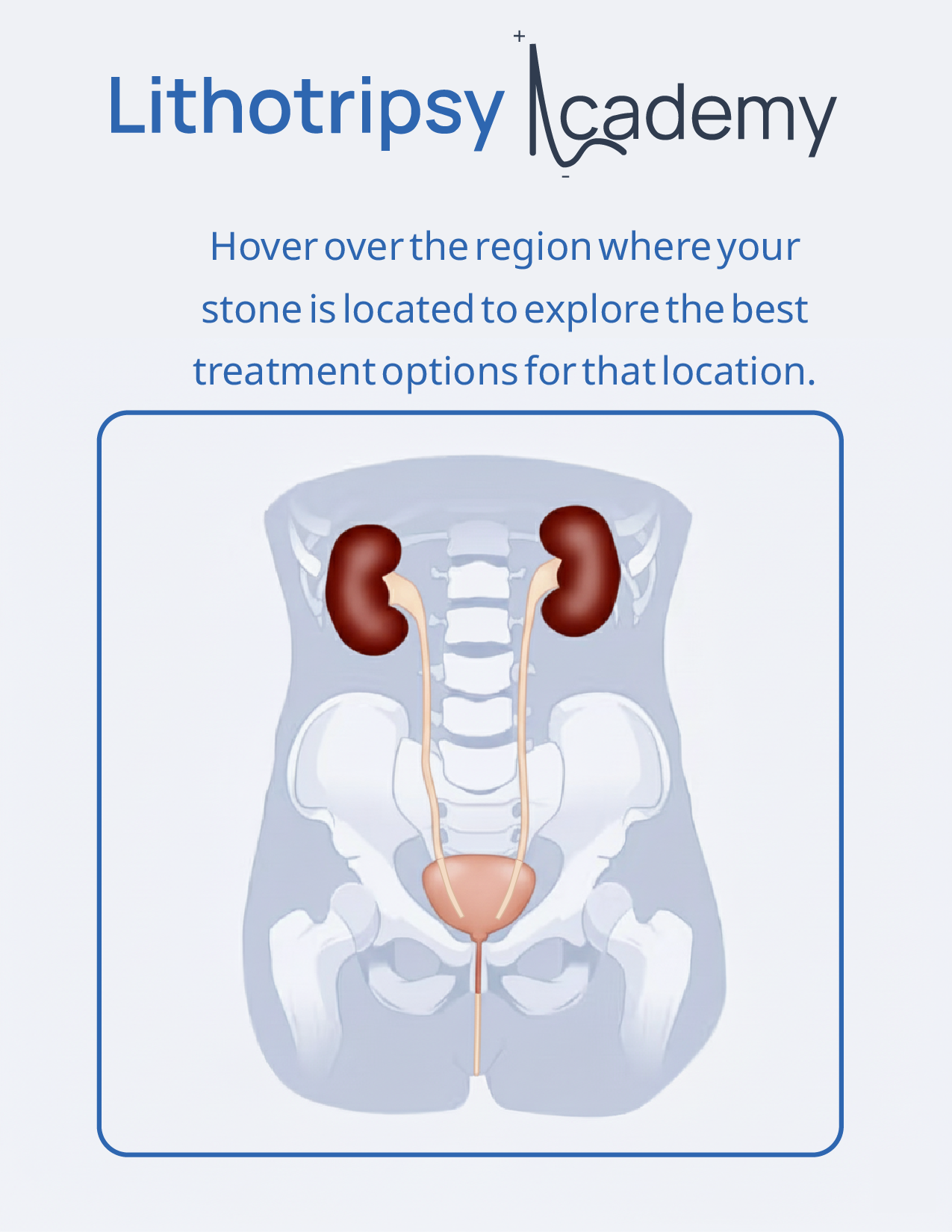
Renal Pelvis stone (right)
If your stone is not larger than 15 mm and its density is below 1000 Hounsfield units, Shock Wave Lithotripsy (SWL) is often the best treatment option. It’s a non-invasive procedure, so you usually don’t need surgery.
Upper pole stone (right)
If your stone is smaller than 15 mm and has a density below 1000 Hounsfield units, Shock Wave Lithotripsy (SWL) is often a good treatment choice — as long as the anatomy is suitable. It’s a gentle, non-invasive procedure, so surgery is usually not necessary.
Lower pole stone (right)
If your stone is smaller than 15 mm and has a density below 1000 Hounsfield units, Shock Wave Lithotripsy (SWL) is often a good treatment choice — as long as the anatomy is suitable. It’s a gentle, non-invasive procedure, so surgery is usually not necessary.
Middle Pole Stone (right)
If your stone is smaller than 15 mm and has a density below 1000 Hounsfield units, Shock Wave Lithotripsy (SWL) is often a good treatment choice — as long as the anatomy is suitable. It’s a gentle, non-invasive procedure, so surgery is usually not necessary.
Upper Ureter stone (right)
If your stone is smaller than 15 mm and has a density below 1000 Hounsfield units, Shock Wave Lithotripsy (SWL) is often a good treatment choice — as long as the anatomy is suitable and the stone is not obstructing for long time. It’s a gentle, non-invasive procedure, so surgery is usually not necessary.
Renal Pelvis stone (left)
If your stone is not larger than 15 mm and its density is below 1000 Hounsfield units, Shock Wave Lithotripsy (SWL) is often the best treatment option. It’s a non-invasive procedure, so you usually don’t need surgery.
Upper pole stone (left)
If your stone is smaller than 15 mm and has a density below 1000 Hounsfield units, Shock Wave Lithotripsy (SWL) is often a good treatment choice — as long as the anatomy is suitable. It’s a gentle, non-invasive procedure, so surgery is usually not necessary.
Middle Pole Stone (left)
If your stone is smaller than 15 mm and has a density below 1000 Hounsfield units, Shock Wave Lithotripsy (SWL) is often a good treatment choice — as long as the anatomy is suitable. It’s a gentle, non-invasive procedure, so surgery is usually not necessary.
Lower pole stone (left)
If your stone is smaller than 15 mm and has a density below 1000 Hounsfield units, Shock Wave Lithotripsy (SWL) is often a good treatment choice — as long as the anatomy is suitable. It’s a gentle, non-invasive procedure, so surgery is usually not necessary.
Upper Ureter stone (left)
If your stone is smaller than 15 mm and has a density below 1000 Hounsfield units, Shock Wave Lithotripsy (SWL) is often a good treatment choice — as long as the anatomy is suitable and the stone is not obstructing for long time. It’s a gentle, non-invasive procedure, so surgery is usually not necessary.
Lower Ureter stone (right)
If your stone is smaller than 15 mm and has a density below 1000 Hounsfield units, Shock Wave Lithotripsy (SWL) is often a good treatment choice — as long as the anatomy is suitable and the stone is not obstructing for long time. It’s a gentle, non-invasive procedure, so surgery is usually not necessary.
Lower Ureter stone (left)
If your stone is smaller than 15 mm and has a density below 1000 Hounsfield units, Shock Wave Lithotripsy (SWL) is often a good treatment choice — as long as the anatomy is suitable and the stone is not obstructing for long time. It’s a gentle, non-invasive procedure, so surgery is usually not necessary.
