

Lithotripsy Technology
Electrohydraulic. Electromagnetic. Piezoelectric.
The traditional classification is correct. But when we want to understand how a lithotripter actually generates and focuses its shockwaves, it may only be the beginning.
Shockwave generation is one of the foundations of extracorporeal shockwave lithotripsy.
Most textbooks describe three principal types of shockwave generators:
1. Electrohydraulic (EH)
2. Electromagnetic (EM)
3. Piezoelectric (PE)
This classification is correct and remains useful.
However, at Lithotripsy Academy, we believe it does not always go far enough.
For someone learning the basic principles of SWL, knowing whether a lithotripter is electrohydraulic, electromagnetic, or piezoelectric may be sufficient.
For someone who wants to understand lithotripter technology in greater depth, another question becomes equally important:
What happens after we identify the basic generator type?
Different lithotripters belonging to the same broad category may use different engineering principles to generate or focus their shockwaves.
For this reason, Lithotripsy Academy uses an expanded practical classification of shockwave generators.
In this article
The Conventional Classification
The traditional classification divides shockwave generators according to the fundamental technology used to produce the shockwave.
Electrohydraulic (EH)
In an electrohydraulic system, the acoustic pulse originates from an electrical discharge in a fluid medium.
Electromagnetic (EM)
In an electromagnetic generator, electrical energy is converted into mechanical movement, creating an acoustic pressure wave.
Piezoelectric (PE)
Piezoelectric systems use a large number of piezoelectric elements that respond to an applied electrical voltage and collectively produce a focused acoustic pulse.
This three-part classification provides an excellent starting point.
But it does not necessarily describe all the important differences between modern shockwave sources.
Taking the Classification One Level Further
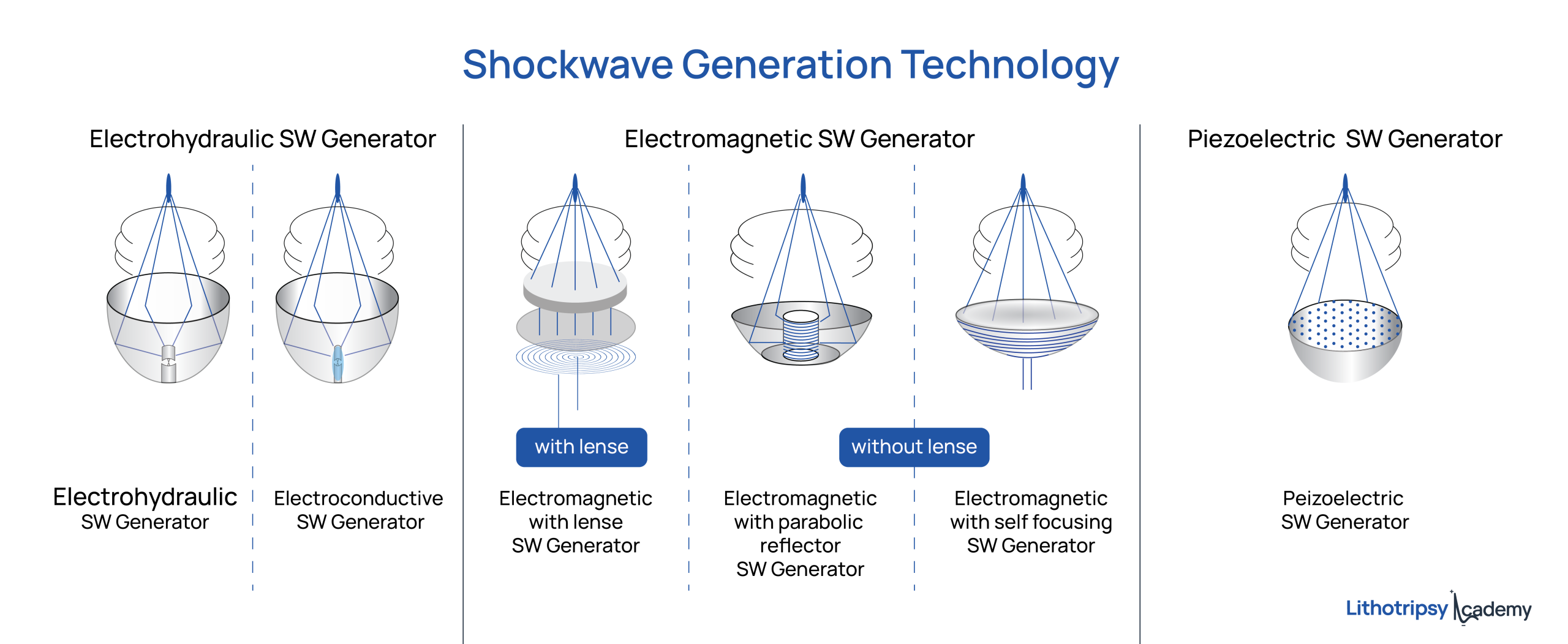
At Lithotripsy Academy, we expand the classification as follows:
Generator Family 01
Electrohydraulic Shockwave Generators
We further divide electrohydraulic technology into:
Conventional Electrohydraulic
This represents the classical electrohydraulic principle traditionally associated with spark-discharge shockwave generation.
Electroconductive
Electroconductive systems represent a further technological development within the broader electrohydraulic family, where the spark plug is covered with the solution to increase the longevity of the electrode.
Although both systems ultimately belong to the electrohydraulic category, their method of creating the discharge and the engineering of the shockwave source can differ.
For someone comparing lithotripters, simply describing both systems as “electrohydraulic” therefore provides only part of the technological picture.
Generator Family 02
Electromagnetic Shockwave Generators
The electromagnetic category becomes particularly interesting when we examine how the generated acoustic wave is focused.
We classify electromagnetic systems into two broad groups:
Electromagnetic With an Acoustic Lens
In these systems, the generated acoustic wave is focused using an acoustic lens.
The electromagnetic source produces the pressure wave, while the lens plays an important role in directing that energy toward the therapeutic focus.
Electromagnetic Without an Acoustic Lens
Not every electromagnetic lithotripter uses a conventional acoustic lens.
Within the lens-free group, Lithotripsy Academy further distinguishes between:
Metal Parabolic Reflector Systems
In this design, the geometry of a metallic reflector contributes to directing and concentrating the acoustic energy toward the focal region.
Self-Focusing Systems
Other electromagnetic source designs achieve focusing through the geometry and construction of the shockwave source itself rather than relying on a separate acoustic lens.
This distinction is important.
Important distinction
Two lithotripters can both be described as electromagnetic, yet the way their shockwaves are generated and focused may be substantially different.
Generator Family 03
Piezoelectric Shockwave Generators
Piezoelectric systems remain the third major category in our expanded framework.
Multiple piezoelectric elements are arranged geometrically so that the acoustic waves generated by the individual elements converge toward a defined focal region.
In this technology, the arrangement of the piezoelectric elements itself forms an integral part of the focusing concept.
The Lithotripsy Academy Classification
The expanded classification can therefore be summarized as:
Shockwave Generators
- Electrohydraulic
- Conventional Electrohydraulic
- Electroconductive
- Electromagnetic
- With acoustic lens
- Without acoustic lens
- Metal parabolic reflector
- Self-focusing
- Piezoelectric
Why Does This Additional Classification Matter?
At first glance, this may appear to be simply a more detailed way of naming technologies.
But there is a broader educational reason behind it.
When studying lithotripsy, we frequently focus on the clinical side of treatment:
- Stone size
- Stone location
- Stone density
- Patient selection
- Shockwave number
- Energy
- Shockwave frequency
All of these are important.
However, the lithotripter itself is not merely a machine producing a generic shockwave.
The engineering architecture of the shockwave source can influence the characteristics of the acoustic field produced by the system.
Therefore, understanding SWL technology should go beyond identifying whether a machine is electrohydraulic, electromagnetic, or piezoelectric.
We should also ask:
How is the shockwave produced?
How is the acoustic energy focused?
What engineering principle creates the therapeutic focal zone?
And ultimately:
What kind of acoustic field is being delivered to the stone and surrounding tissue?
Two Electromagnetic Lithotripters Are Not Necessarily the Same
This is perhaps one of the most important reasons for expanding the traditional classification.
Consider two lithotripters that are both described as electromagnetic.
At the textbook level, they belong to the same category.
One may use an acoustic lens.
Another may use a reflector-based focusing system.
Another design may incorporate focusing directly into the geometry of the shockwave source.
Calling all of them simply “electromagnetic” is technically correct.
But for someone trying to understand how the machines actually work, the description may be incomplete.
This is similar to many other areas of medical technology.
Knowing the broad technological family is important, but understanding the engineering within that family provides a much deeper appreciation of device performance and design.
Moving From Machine Classification to Technology Understanding
One of the educational goals of Lithotripsy Academy is to move beyond memorising definitions.
We want professionals working with SWL to understand what is happening inside the technology they use.
Instead of asking only:
“Is this machine electrohydraulic, electromagnetic, or piezoelectric?”
We encourage a second level of questioning:
What type of electrohydraulic system?
What type of electromagnetic source?
How is the wave focused?
What creates the focal zone?
These questions lead to a more meaningful understanding of lithotripter design.
This Is a Practical Educational Framework
It is important to make one distinction clear.
The expanded classification presented here should not be interpreted as a replacement for the established three-category textbook classification.
The traditional classification remains scientifically useful.
Instead, the Lithotripsy Academy framework is intended as an additional educational layer.
It takes the traditional classification and asks:
Can we go one level deeper?
For clinicians, technicians, engineers, application specialists, and anyone interested in the technology of SWL, we believe the answer is yes.
Understanding lithotripsy means understanding not only the stone and the patient, but also the technology delivering the shockwave.
Sometimes, the textbook classification is only the beginning.
Lithotripsy Academy
Driven by Expertise